fitness

Fear of Open Water Swimming

Not the fear that open water swimmers might feel about sharks, jellyfish, tides, weeds, or snapping turtles. This is the fear that open water swimmers might have too much fun. Or start a lawsuit. Or something. It is rapidly becoming a trend and I am not happy.

First up, Walden Pond, the idyllic home of philosophers Ralph Waldo Emerson and Henry David Thoreau. Last week, state legislators in Massachusetts banned open water swimming there, as part of an effort to address water safety following a spate of drownings across the state. Of note, I could not find reports of any drownings at Walden Pond itself. Thankfully, as of July 9, open water swimmers will be allowed back in, only at times when there are no lifeguards on duty, and only if using a swim float (which most already do).

Then we have the Cam, where people have been swimming at least since the time of the poet Byron in the early 1800s. Technically, Grantchester Meadows, the access area, is owned by King’s College Cambridge, but they are managed by the local council as public space. King’s College abruptly put up no swimming signs last week, as they said their legal advice was that “use at own risk” was insufficient. Again, no evidence of actual drownings. Following another outcry and 18,000 signature petition (known as the peasants’ revolt) the decision was reviewed but the ban will stay.

A spokesperson for the university stated “We have every wish to temper the language of ‘no swimming’ to a less prohibitive form of words, but feel unable to do so without the express support of the [district and parish] councils and their health and safety officers. We hope they will be willing to co-operate on this and bring the ‘ban’ to end.” But it will not officially reinstate swimming unless its insurers agree the college is not liable should anyone be injured while swimming. Meanwhile, there are no plans for lifeguards, patrols, or any of the normal provisions to increase water safety.

The Hampstead Ponds near London are former water reservoirs, originally dug in the 17th and 18th centuries. There are three separate swimming ponds: for women, men and mixed. Access to ponds has been cost-free since at least the 1920s; though a fee had been charged since 2005, payment was not enforced. Last year, a mandatory payment system was put in place, and prices more than doubled (and were subsequently raised again).

Some free swims were still available, but times did not align with when low cost public transit was available, which meant those with mobility issues or low incomes could not benefit. According to the Kenwood Ladies’ Pond Association (KLPA), the ladies’ pond had historically provided a sanctuary for women and girls, including those with disabilities, victims of violence and abuse, and those from faith groups that demand modesty, but the new charging system was proving exclusionary for many people. Even before the most recent price rise this year, the KLPA conducted a survey of 600 swimmers and that found the charges had affected affordability for 58% of them. As a result, more than half now swim less often and 25% can no longer afford to swim at all.

Closer to home, several lakes managed by the National Capital Commission (NCC) and used by open water swimmers for many years are now under new rules that limit the ability of open water swimmers to train. At Meech Lake, the most popular spot, parking hours have been shortened, and swimmers must either swim along lanes marked by buoys, or within 30 metres of the shore. This seems to be counterproductive, since one of the main issues noise complaints – until now, most swimmers have preferred to stay nearer the centre of the lake). Swimmers must wear a colourful cap and a float, which most already do.

The conflict arose because of complaints by homeowners about noise and traffic on the main lake late at night. I can’t speak for all swimmers, but all those I know prefer to swim early in the day, so I suspect swimmers are getting the blame for other partiers. But really, it seems to be boiling down to the NCC’s unwillingness to uphold its mandate of protecting the ecology of the area. Why are all these new monster homes and powerboats being allowed? What will it take to stop power boats from traveling at speed through the designated swim lanes? So far, complaints to the NCC, supported by photos and videos, have not been effective. But there is an active alliance of open water swimmers on Facebook that is working hard to make the best of the situation.

And just down the street from my house, we have the Pond. It has always been an elitist spot. When I first started swimming there, I was questioned about how long I had lived in the area. It was nice to be able to say “25 years”, but it would have been nicer to have known about this closely guarded secret much earlier. I found out about it because my son hung out with the rich kids and mentioned it. It only became popular after a local blogger spilled the beans.

The swimming hours are from 7am to 2pm, supposedly because it is a conservation area. But really, turtles and herons can’t tell time. It is more about keeping out potentially rowdy teenagers who don’t wake up before noon.

Now, thanks to complaints about overcrowding, one or two Bylaw officers are at the beach every single day, to keep the numbers down to 10 in the changing area and 10 on the beach. I just love seeing my tax dollars at work (insert sarcasm emoji here).

The Pond, with a few swimmers and waders

As one of my friends said, “In every one of these cases, the increased access to information has in many ways just underscored how actively shitty so many people are.” Keep on shining a light on inequity and fight on for access to public swimming spaces, my friends!

fitness

Swimming Outdoors – Don’t Win a Darwin Award!

That advice came from a session on safety when open water swimming I attended this week. The session was organized by the Rideau Speedeaus, an Ottawa swim club, and there were three presenters.

Chris Wagg has been with the City of Ottawa as a lifeguard and trainer for 35 years. She started out with some drowning statistics for Canada. Next up was Nadine Bennett, a well-known open water and cold water swimmer in Ottawa, who blogs at https://www.wildbigswim.com/. The last speaker was Jeff Mackwood, a lifeguard and the person who set up the Swim Angel program for Ottawa’s 3 km Bring on the Bay swim, which has made it very accessible to those with disabilities, recovering from injury, or nervous about open water swimming.

On average, there are about 500 drownings a year in Canada, with 64% in May to September, 64% in lakes or rivers, and over 60% when swimming alone. The percentage of drownings among middle aged and older people swimming alone is much higher. Obviously, not all of these drownings are among open water swimmers, but it was a good jumping off point for some basic swim safety when swimming outdoors.

  1. Swim with a buddy. If you can’t then at a minimum let people know where exactly where you will be swimming and when you expect to be back.
  2. Medical emergencies are more frequent as you get older – have a buddy who can call for help, loan you a float, or just coach you back to shore.
  3. Make yourself as visible as possible in the water. Wear a brightly coloured swim cap and a tow float. If available to you, especially for longer swims or where there might be boats, having a kayaker to go alongside is even better. If you are swimming early in the morning or late in the evening, invest in some lights you can attach to your wrist and swim goggles
  4. Tow floats are not official flotation devices, but they do float, so you can use them to rest on. They are also good for holding snacks, drinks, your car keys, phone and other valuables (be sure to put them in a waterproof bag just in case the float leaks). Write your name and a phone number on the float, in case of an emergency.
  5. If you don’t have a tow float, tie a rope to a pool noodle. It won’t hold your keys, but it will make you visible and you can rest on it in the water.
  6. If you are new to swimming in open water, or out of practice, start out easy. Do short loops. Stay close to shore. Stop for a rest or snack as needed, then go back in if you are ready. If you are nervous or out of shape, find a supervised beach and swim along the buoy lines.
  7. Learn to breathe regularly even when there are waves (bilateral breathing is a really useful skill). Also practice swimming in a straight line by picking a target, then peeking up every few strokes with “alligator eyes” just barely out of the water to make sure you are still heading in the right direction.
  8. Listen to your body. Especially if you are going in the shoulder seasons of May or late Fall, pay attention to your breathing and heart rate, and whether you are losing the ability to move easily in the water because you are cold. Make sure you have a plan to get out and changed into warm dry clothes quickly. You may experience “after drop”, shivering as the blood starts circulating. Wait until that has passed before trying to drive home.
  9. Pay attention to the weather and be prepared to get out quickly if a storm rolls in. Swimming in the fog or dark can be dangerous. This is what can earn you that Darwin Award.
  10. Above all, have fun. Practice some drills. Do other strokes than freestyle. Take pictures. Admire the scenery. Revel in the freedom of being in a wide open space with glorious water all around.
Diane and her sister floating in a river.

Diane Harper is a long-time open water swimmer from Ottawa. She isn’t fast, but she has a lot of fun.

fitness · swimming

Wild swimming? Cold water swimming? Whatever you call it, Sam is tempted to try it

Here on the blog we’re having lots of thoughts about cold water!

Catherine dipped her toes in and is thinking about more. Blog regular Diane Harper wrote about winter swimming back when she was a guest poster. Another regular guest Lynette Reid has been tempting me in with her beautiful Nova Scotia winter swimming pictures. She blogged about it here. And I’m officially on record, along with Catherine, as intrigued and tempted. See also here.

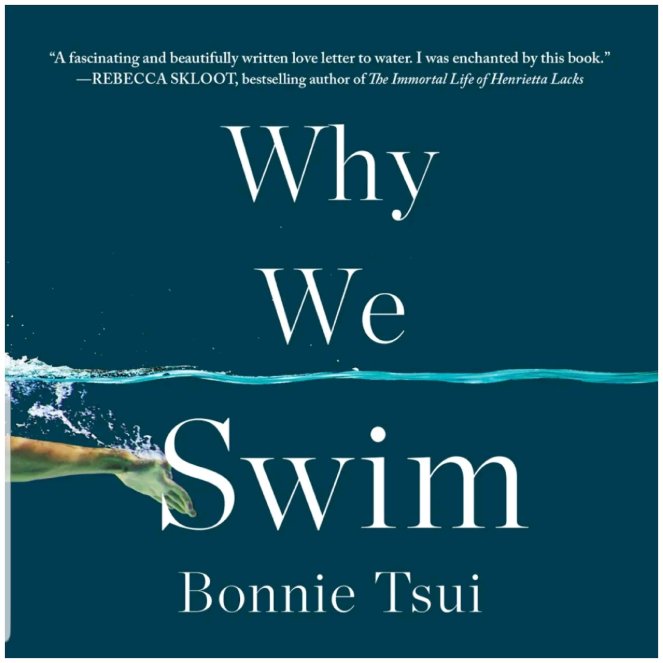
We’re also, as a group, reviewing Why We Swim by Bonnie Tsui. We usually do it chapter by chapter, book club style, so readers can join in. Details to follow later this week! (And yes, in the interests of transparency, that’s an Amazon affiliate link. We don’t make much from them but they do cover the costs of an ad-free WordPress blog.)

The cover of Why We Swim

Here’s the back of the book blurb: “An immersive, unforgettable, and eye-opening perspective on swimming—and on human behavior itself. We swim in freezing Arctic waters and piranha-infested rivers to test our limits. We swim for pleasure, for exercise, for healing. But humans, unlike other animals that are drawn to water, are not natural-born swimmers. We must be taught. Our evolutionary ancestors learned for survival; now, in the twenty-first century, swimming is one of the most popular activities in the world. Why We Swim is propelled by stories of Olympic champions, a Baghdad swim club that meets n Saddam Hussein’s palace pool, modern-day Japanese samurai swimmers, and even an Icelandic fisherman who improbably survives a wintry six-hour swim after a shipwreck. New York Times contributor Bonnie Tsui, a swimmer herself, dives into the deep, from the San Francisco Bay to the South China Sea, investigating what about water—despite its dangers—seduces us and why we come back to it again and again.”

What’s ‘wild swimming’? As Rhiannon Lucy Cosslett in the Guardian notes we used to just call it ‘swimming’ or ‘outdoor swimming.’ It’s like ‘forest bathing’ which used to just be called ‘hiking in the woods.’ What’s new is an emphasis on the physical and mental health benefits. And wild swimming often involves swimming off season–not just in the hot summer months, but fall and spring, and for some of the braver souls like Diane and Lynette, wintertime too. I don’t think the term has quite taken off here in Canada like it has in the UK.

Why am I tempted at all? Here’s my two main reasons:

  • Fond childhood memories of Newfoundland and Nova Scotia. On the east coast of Canada the beaches always meant cold water swimming even in July and August. Mostly kids went in while adults huddled on shore. I want to recapture some childhood feels. Biking does that. Maybe cold water swimming will too?
  • I love swimming outside but I can’t seem to get into pool swimming. I like indoor rowing (hi erg!) and outdoor rowing. I love indoor biking (hey Zwift!) and outdoor riding. But swimming? Nope. No matter how much I try it’s never taken. But I love being in the water outdoors.
May be an image of 1 person
This picture always makes me laugh. It’s in PEI in August first of all. Also, my kids are frolicking in the outdoor swimming pool on family vacation. Me? I’ve become one of those adults huddled on shore, wearing Jeff’s polar fleece jacket, drinking Tim Hortons coffee, while the kids play and have fun in the water. What happened to me?

Okay how do I move from ‘feeling intrigued’ to ‘giving it a go’? I asked some of my winter swimming friends for advice. Should I wait until summer? Start now?

Albert Nerenberg, a friend from my undergrad student newspaper days, writes, “You can really start any time because the two key components are the breathing and the cold showers. You can get most of the benefits from cold immersion from those two practices. But people naturally escalate to outdoor swimming. Cold exposure doesn’t have to be long. 3-5 minutes for benefits. So anytime is good because the breath warm up can be done with even warmer water and you’re still in the process.”

Brrr!

Albert is an advocate of the health benefits of both cold water swimming and laughing. He combines them in this video.

Here’s the specific breathing technique Albert recommends.

Lynette’s words of wisdom? “One piece of advice people give is to acclimatize over a few years and extend the season rather than starting early. But last year I started early because who wants to hear that in April? Go in slowly (walk I don’t dive) and monitor your breathing so you start to notice when you involuntarily hold your breath or take a breath in and re-establish it before going in farther. Wind is a worse enemy than temperature.”

What about special gear? Do I need any?

“You can put neoprene gloves booties and a cap on. Or wetsuits or whatever versions of wetsuits triathletes wear which have greater mobility. Or your bathing suit. At the beginning you just get in and out. Dip. Swim later. Never push yourself with goals and expectations in cold water swimming. Get warm after,” says Lynette.

Also, research safety tips before you go. Here’s cold water tips from Outdoor Swimmer magazine and more tips from the outdoor swimming society.

Here’s Lynette, photos from her earlier post.

Diane also recommended safety first. (We’re like that here on the blog!)

She writes, “I would start with Nadine’s website, which has lots of info based on years of training for cold swimming. My advice would be to listen to your body and don’t ever push beyond your comfort zone. Everyone is different and some very experienced long-distance open water swimmers can’t get in, while other people find it relatively easy. Some use wetsuits, others don’t (I don’t because I worry about struggling to change out of a wetsuit when I’m cold). Personally, I found that just extending my season in the fall was the best way to do it. But when I was swimming today, I saw a man, a kid and a dog all in the water, so now is also manageable.”

The colder it is, the more you need to be concerned about safety.

“In cold weather, wind and precipitation can be brutal, both physically and psychologically. The usual water safety rules apply more than ever – swim with buddies, have a plan, know your swim area, wear a float for visibility, especially if there are boats or windsurfers in the area. Bring snacks for when you get out as you will be hungry – cake is traditional,” says Diane.

I wondered if most people actually swim in the water or if it’s more ‘get in, get out’ like the polar bear dip.

Diane says she actually swims.

“I actually swim, but there is usually some time spent getting acclimatized. Sometimes it’s all head’s up breaststroke because putting my face in is too hard. Today it was about 350 m I think, and I was in for a little over 20 minutes. I would have stayed in longer but my swimming buddy is new to it and she was starting to get cold. The colder it is, the harder it is, obviously. I have trained for an ice mile (bathing suit and one cap, not gloves or socks, in water under 5C). I will never do one because I’m just not fast enough to complete that distance in under about 40 minutes, which is extreme. But a day like today, with water at or above 10C, 45 minutes is easy now.”

Here’s Diane and her friend Nadine making the cold water look as welcoming as a hot tub.

What’s next? Well, I promise to give swimming outside this spring, earlier than usual, a go. And I’ll report back. If Catherine lived closer–damn you geography and borders–I’d give her a call and we’d go swimming together.

I also want to write about British swimmer Kate Steele who has done not one, not two, but EIGHT ice miles! What’s an ice mile? “Find a body of water that is below 5C, and swim one mile under supervision wearing only your swimming costume, a pair of goggles and one silicone swimming hat.”

And stay tuned for our group book review of Why We Swim.