FIFI bloggers often write about their adventures fundraising for various causes: Sam’s pedaling for Parkinson’s springs immediately to mind, but she has a whole list of upcoming rides. I often swim at Bring on the Bay, sometimes raising funds for Easter Seals and sometimes supporting other swimmers. As a swim angel, I can’t fundraise directly, but you can support anyone from my club here.
Last week I spent a whole day being active while volunteering. It’s one of the nicer things about being retired.
First up, I spent two hours picking mulberries with Hidden Harvest, an organization that harvests unwanted fruit and gets it to various agencies addressing food insecurity in Ottawa. It wasn’t super strenuous, but there was plenty of reaching and bending.
My next stop was a three hour shift with the National Capital Commission’s archaeology program. As part of its commitment to reconciliation, the NCC tests every site that might have been used by Indigenous communities before any construction or other work is done. In this case, we dug test pits in a field that is to be reforested.
Each pit is about 18 by 18 inches, and we dug down until we hit undisturbed soil – sometimes two feet or more deep. Every shovelful of dirt then had to be screened for artefacts. I think we managed four holes in three hours. We didn’t find anything of significance, so it looks like the reforestation project will go ahead.
Top: Laila, the archaeology summer student, takes photos and measurements of our work. The dirt we have sifted sits below the sieve on a blue tarp in the foreground, waiting to be returned to the hole once she is done. Bottom: some of the mulberries from our harvest.
Yesterday was Canada’s National Day for Truth and Reconciliation, a day to reflect on the legacy of residential schools and their impact on the indigenous peoples. I decided to join a couple of formal events and then ride out to a site in Pointe Gatineau I had read about. It seemed especially appropriate to do everything by bike today, to leave a light footprint on the land.
My tour started at Beechwood Cemetery in Ottawa, where we did a short walk to the graves of four people connected to residential schools. Then I rode downtown for another walking tour of sites mostly connected to Dr. Bryce, the man who first reported on the conditions at residential schools over a century ago. Both tours were led by young indigenous people, mostly Anishnabe (Algonquin) from Kitiganzibi and Pikwanigan.
An indigenous man holding an eagle feather leads a tour, surrounded by people wearing orange shirts. Orange shirts recall a girl whose orange shirt was taken from her on the first day of residential school and never returned, so they are a symbol of forced assimilation.
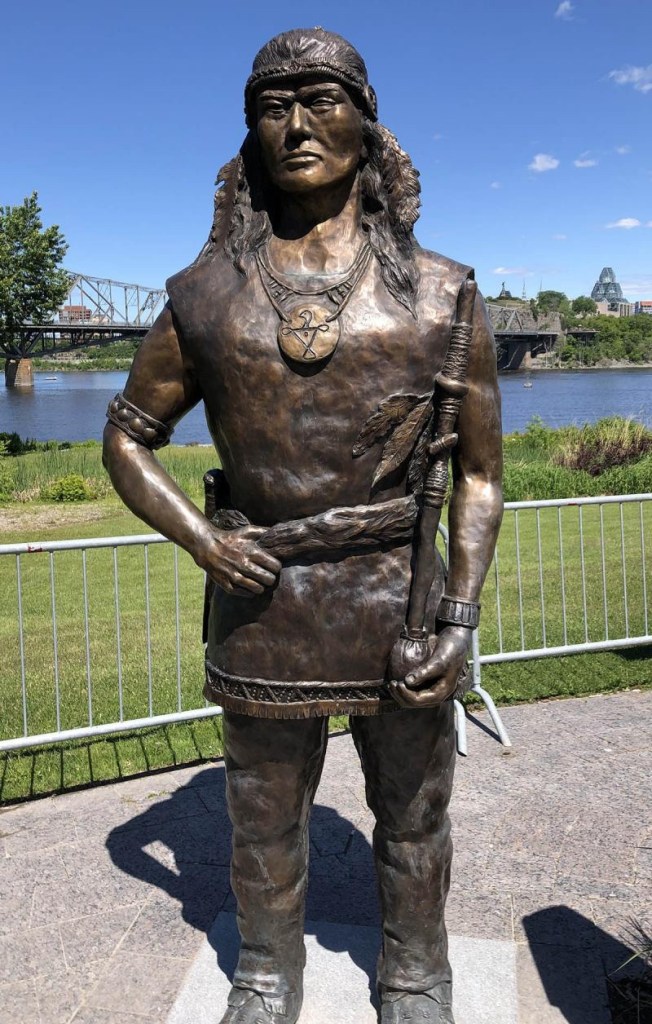
This was the first time I had heard about an indigenous burial ground downstream from the waterfalls in the Ottawa River, very near the Canadian Museum of History. So, across the river I went. I couldn’t identify the spot, but I did find a plaque about the history of the Anishnaabe who have lived and traded in the Ottawa area for thousands of years, plus a statue of Chief Tessouat, who was party to the first major alliance between Europeans and the First Nations, 400 years ago.
A metal statue of an indigenous man in traditional clothing, with the Ottawa River in the background.
I continued along the Voyageurs Trail, a 30 km route, towards Pointe Gatineau. There were more plaques with bits of history, and I stopped to read them all. I am a bit of a plaque nerd.
The next spot of interest was near a bridge I had never noticed before. Called Mawandoseg (land where our people once gathered), there is also a statue in the form of a stone point, to recall the artifacts found here that show the site had been used for millennia.
The back of a statue in the form of a stone spear or arrow point.
My next stop was in Pointe Gatineau, at Place Abinan (the people were here), a little park near the water. When excavated, this area had proven use dating back 7,000 years, with people traveling or trading widely. From just a few metres away, it was possible to see the confluence of the Ottawa, Gatineau and Rideau Rivers, waterways that made this such an important site for trade.
In the foreground is the Gatineau River as it joins the Ottawa River. On the far side, in the centre, you can just make out the Rideau Falls, where the Rideau empties into the Ottawa.
Looking across the river, I remembered the Chief Pimisi portage route around the falls, so that’s where I cycled to next. I rode through Rockcliffe Park but decided not to tackle walking down to the water, since there was no place to lock my bike. I did get a selfie looking back towards Pointe Gatineau.
Me in a turquoise and white sweater and bicycle helmet, with an orange shirt pin. In the background are trees just beginning to turn yellow and orange. place Abinan is barely visible in the far distance near my left ear.
Finally, it was time to head home. It ended up being my longest ride in years, somewhere between 27 and 28 km. Since I wasn’t wearing proper riding gear, I was grateful for all the breaks along the way. But even in proper gear, I think this was a good way for me to do a longer ride. It allowed me to combine my love of history and social justice issues with a fitness activity.
My daughter Mallory is almost done the Otesha Project’s East Coast Tour. And I’m very proud of her. We’ve been riding together since not long after she was born. (Thanks Burley bike trailer.) We’ve done lots of mother-daughter bike tourism together, the rail trails of Quebec and of New Zealand’s south island (see Cycling holidays, Part 1: Rail trails) but I love that this summer she’s off riding her bike with a group of like minded young people and has discovered her own love of cycling.
This summer she also moved to clipless pedals and I might even have talked her into a touring road bike for future mother-daughter cycling adventures!
What’s the Otesha Project?
“The Otesha Project is a national youth-led charitable organization that uses experiential learning, theatre and bicycle tours to engage and empower Canadians of all ages to take action for a more equitable and sustainable world.”
Riding the Tides of Change Fredericton to Halifax May 3 – June 24 2014 Performing and Cycling Tour
Here’s their description of the East Coast Tour: “Let the cliffs, culture, and concentration of sea life in Canada’s majestic Maritimes fuel your passion for sustainability and social justice . A 9 day training in bicycle skills, interactive theatre, community engagement, and facilitation techniques prepares your team to spark dialogue with thousands of students using Otesha’s play “Cycling Through Change” and “Action Addict” workshop. Wind your way around the Bay of Fundy and through the Annapolis Valley, learning from the Mi’kmaq, anglophone, and Acadian communities that welcome you.”
And if you’re in, or near, Halifax you can meet them on Thursday, June 19th!
“The Otesha Project is rolling into Halifax after our 2 month East Coast Cycling and Performing Tour talking with schools and communities about environmental and social justice! Come join us in Victoria Park at 5 pm for a public performance of our play (rapping and singing included) and a critical mass ride around the city at 6pm!!” See details here.
Here’s some of child Mallory in her early days as a cyclist!