fitness

Fit is a Feminist Issue – and an Infrastructure Issue

I have been involved in a lot of conversations about active transportation in the last few weeks. And about the reasons both kids and seniors may be less active than they would like. And Mount Alison University geograph Professor Leslie Kern talking about her book Feminist City (my copy is on order).

And far too many rants where cyclists were blamed for being struck by cars, articles were written about pedestrians hitting cars (the cars drove away – never the drivers – and the pedestrians were hospitalized). The worst was blaming an older man for daring to go for on walk on a bare sidewalk in regular shoes, after he broke his ankle when trying climb over a windrow left by a snowplow.

What if we designed our living spaces so that more of us that are enticed to walk, bike and take transit, because the more that they do, the better it is for everyone?

Women in Urbanism Canada points out that women make up more than half of Canada’s aging population, so building age-friendly cities must be gender-inclusive. Women are more likely to outlive their partners, live in poverty, earn less, own less property, and have children and grandchildren to care for. They are more likely to suffer from mobility-related disabilities and physical impairments. They may also outlive their ability to drive. They need affordable and well-connected public transportation, areas to exercise and socialize and homes that allow them to live, independently, and with easy access to services resources and community amenities.

And the city of Ottawa, in a zoning review paper currently under discussion notes that “the impacts of car-dependency are most acutely felt by women, youth, elderly people, low-income people, and people with disabilities, as these are all people who are less likely to have access to or afford personal vehicles. A mobility-rich neighbourhood is a 15-minute neighbourhood where kids can walk to school and recreation, where people have the option to run a quick errand on foot, and people of all incomes can affordably access their needs.”

So what would that activity-friendly neighbourhood look like? It would have public transit, wide sidewalks and bike spaces (maybe even car-free), with benches, bathrooms, trees for shade, meeting places and playgrounds, plus a variety of shops and services close to home.

Click on this link to see a short video of what I think is a practically perfect active living space.

A street with dense housing, trees, playground, bike racks, and people of all ages walking or cycling. The drawing comes from The cover of Curbing Traffic, a book on the human case for fewer cars by Melissa Bruntlett and Chris Bruntlett.

For winter in Canada, I would add ploughed sidewalks and bike lanes. Sweden has already led the way on this. Following a gender analysis of its street clearing practices, Swedish cities began clearing sidewalks first, because they discovered that women were more likely to walk. There were three times as many injuries from falling on slippery streets as there were from driving, and the cost of treating those injuries far outweighed the city of snow clearing.

For millions of short journeys, the right tool for the job ought to be walking or cycling, but the way too many streets are designed makes this a difficult choice. Cars go too fast, there are no safe spaces for bicycles, and sidewalks have obstacles including high curbs, unsafe crosswalks, and buttons to beg for a pedestrian light that my not even be accessible to all users.

That’s a shame, because person on a bicycle can go three to four times faster than the pedestrian, but uses five times less energy in the process. Equipped with this tool, humans outstrip the efficiency of not only all machines but all other animals as well (Ivan Illich, Energy & Equity, 1973).

Brent Toderian, the former chief planner for the city of Vancouver, has written that “the recent Paris transformation of key streets to add bike infrastructure is intensely pragmatic – more mobility choice and more trips using a lot less space, lower public cost, lower emissions, less pollution, better public health, etc.”

The Tyee wrote last year about how various people with disabilities were using bike lanes and how the lanes could be even more accessible. I found it really eye-opening.

All this infrastructure is not just a feminist concern. It can also have a real impact on our health. Recently there was a meta-analysis of the impact of moderate physical activity on health. According to the report I read, about one in ten deaths could have been prevented with a little as eleven minutes of moderate physical activity a day. I’ll leave it to Catherine Womack to assess the claims; why I thought was important for this blog was the final quote:

´Dr Leandro Garcia, of Queen’s University Belfast, emphasised that moderate activity did not have to involve what people normally thought of as exercise, such as sports or running. “For example, try to walk or cycle to your work or study place instead of using a car, or engage in active play with your kids or grandkids,” he said.´

Imagine if we had safe and accessible places to do that…

Diane Harper lives in Ottawa. She has been a commuter cyclist for over 20 years.

fitness

My bike is a mobility device – who knew?

As a kid, my bike was for fun. As an adult, I have always thought of myself as a commuter cyclist. I was never interested in road racing, or cross-country cycling or any of the other specialized cycling options involving fancy bikes and Lycra.

I have realized, however, I actually need my bike as a mobility device. I live close enough to my work place that I can walk. Except:

  • when it is too hot
  • or too cold
  • or when the sidewalks are icy
  • or when the sidewalks are unploughed.
  • or I have my laptop and my lunch and who know what else to haul in a backpack.
  • or when it’s raining
  • or when my feet (knees, hips) are sore.
My poor sore feet. The left one has a scar from past bunion surgery. The right one show a growing bunion that will eventually need surgery.

I am not the only one. People who have e-bikes use them for far more than short leisurely rides. A recent study about e-bike use in Norway found that “The people who bought e-bikes increased their bicycle use from 2.1 kilometers (1.3 miles) to 9.2 kilometers (5.7 miles) on average per day; a 340% increase. The e-bike’s share of all their transportation increased dramatically too; from 17% to 49%, where they e-biked instead of walking, taking public transit, and driving. You can read more about the study here.

Melissa and Chris Bruntlett are Canadian urban mobility advocates and authors of Building the Cycling City, The Dutch Blueprint for Urban Vitality. In their view “Cycling is, for many people, a powerful mobility tool. Moreover, building wide cycle paths also helps create space for people that are on tricycles, adapted cycles, mobility scooters, and other modes.”

Adult tricycle with two child seats on the back and a wire basket on the handlebars. Photo is by Peter Biczok, who spotted it in Hungary.
An older woman with her hair in a ponytail and wearing a large knapsack rides an electric tricycle in Leiden, Netherlands. The tricycle is laden with packages and bags in the back, on the front and from the handlebars. Photo originally shared by Melissa and Chris Bruntlett on Twitter.
A woman rides a hand-powered adapted electric tricycle in Amsterdam. She is accompanied by a husky-type dog on a leash. Photo originally shared by Melissa and Chris Bruntlett on Twitter.

For now, I am perfectly content with my regular winter and summer bikes to get around. But I can definitely see a an electric bike or a regular/electric cargo bike or trike in my future.

fitness

Healthy Active Living is Exhausting!

I live in an area where cycling makes a lot of sense for everyday tasks. I can get to work, the grocery store, and most essential shops easily and safely by bicycle or on foot.

As gas prices rose this fall, I started a little personal challenge of not using my car more than once a week. I was already riding my bike to work on my days in the office, so this shouldn’t be a big additional burden, right?

I don’t know. My sample size is very small, and I didn’t set up a good research question in advance. My evidence is purely anecdotal.

I can tell you that I’m tired. Far more tired than I expected. But I’m still doing it, mostly. Even if it meant I needed a long nap after cycling to swim practice and to buy groceries on Saturday. I did get up on Sunday to bike to church.

Me in a green coat and blue bicycle helmet, with my bicycle. There is snow on the ground and a snowy hedge in th background. I appreciate that my church has bike racks. I also appreciate my black pogies, which are just the thing to keep my hands warm in winter.

A little bit of my tiredness is undoubtedly because being nervous about sharing the road with cars is exhausting. Even though I am getting more confident, I miss the separated lanes and bike paths that are available to me in summer.

And sidewalks often aren’t clear for pedestrians, so walking isn’t fun either. In fact, the closest I have come to an accident was when a pedestrian using the road jumped into my path to avoid being hit by a car.

If we really want people to adopt active living, which has huge benefits for overall health, accessibility and the environment, we need to push our civic leaders to invest in infrastructure that supports people to use non-car transportation year-round. And leaves them less tired and stressed from the effort.

Diane Harper is a public servant in Ottawa, and a recent convert to year-round cycling.

fitness

I’m a Winter Cyclist (for real!)

Way back in September I wrote about winter cycling and now that wintery weather is here, it’s time for an update. TLDR: I like it!

It took me a few tries to get my gear to my satisfaction. The seat was lower than I remembered. I needed to move some lights and my basket. I accidentally installed my bell upside down (still need to fix that). My pannier actually works better with the new bike than it does on my summer one, so that’s a bonus.

And then there were clothing questions: which hat fits under my helmet? Surely I have a balaclava or two in the closet? I did find my rain pants so I can block the wind on chilly days. My woolen mitts work for now, but I have a pair of pogies in my Amazon cart that I will need to order before it gets much colder.

It’s harder to pedal than my summer bike because of those studded tires that keep me safe on the ice. But I sure appreciate them on the section of pathway that doesn’t get ploughed in winter, despite heavy use by walkers and cyclists. Eventually I will need to choose a different route to work; it will be on quiet streets, but I’ll miss the paths that keep me completely separated from vehicle traffic.

Snow-covered path filled with foot and tire prints, in a snowy park under grey skies. There are park benches and trees along the path, and a building with a construction crane in the distance.
Snow-covered path covered with foot and tire prints, in a snow-covered park under grey skies.

I make sure I’m really visible, with a reflective construction vest and bright head and taillights. I’m still fussing a bit with the fairy lights, but they work well and look rather pretty in the dark.

Bicycle with lit fairy lights wrapped around the front basket and frame, inside a darkened storage room. There is snow on the tires of the bicycle, and the wheel of another bike in the front left of the picture.
My bike with the fairy lights lit, inside my storage area so they will show up in the dark.

The best part of being a winter cyclist is the camaraderie with other cyclists, and the feeling that you’re a bit of a badass. I love the community of people sharing pictures of “not taking their kids to daycare” or “not going to the grocery store” because “no-one bikes in winter”.

White woman wearing an orange and yellow construction vest over her coat and a hat and ear protectors under her helmet. Her red and white bicycle is parked in the snow, with houses in the background.​
Diane, “not biking in winter”, while wearing an orange and yellow construction vest over her coat and a hat and ear protectors under her helmet. Her red and white bicycle is parked in the snow, with houses in the background.

Diane Harper lives in Ottawa.

fitness

Bike lanes, accessibility and health

The mayoral elections in Ottawa this week were largely defined by transit issues, and nearby Montreal Road, in the community of Vanier, was recently reopened as a complete after three years of construction. As a result, bike lanes and accessibility have been very much on my mind.

I stopped in for the grand reopening of the street; there was a large crowd of people who had come on foot, by bicycles of all kinds, in strollers, or on scooters. The new street features wider sidewalks and separated bike paths for most of its 2 km length, along with improved infrastructure for the bus service.

That’s me! I’m the cyclist in a beige coat and blue knapsack riding away on a separated bicycle path adjacent to an urban street with many small shops and low-rise buildings. Photo by Sarah Kester/CBC

Why does this matter to a fitness blog? Because that street is in a relatively poor part of town, where many people don’t own cars. There are lots of immigrants, kids, many people with disabilities, and the local bus is among the busiest in the city. A complete street like this one means that people can get around more safely.

Surveys have shown that cycling numbers increase significantly when there is safe infrastructure. People will cycle year-round if the paths are cleared. In Ottawa, the number doubled between 2015 and 2020, even though the winter cycling network has only about 50 km of maintained routes. Even if you are a fair-weather cyclist, it is easy to manage at least some trips for 7-8 months of the year if the roads are safe, since the average trip in the downtown area is less than 4 km according to Ottawa’s 2013 Official Cycling Plan.

Other people using wheels also benefit from those separated bike lanes – whether it is little people in strollers or those using wheelchairs or mobility scooters. In fact, I shared a good chunk of my last ride to Canadian Tire with a guy on a mobility scooter.

Transit has been strongly linked to higher rates of active travel and physical activity. However, as Journal of Transport & Health notes, the associated physical health benefits must be weighed against potential health threats. “For instance, in terms of safety from vehicle traffic or emissions, walking and bicycling to transit can be riskier travel options than other modes due to their higher levels of physical and environmental exposure. For this reason, by travel distance, active travelers suffer from injuries and fatalities at a higher rate than drivers. Additionally, walkers and bicyclists may suffer disproportionately from vehicle emissions compared to other modes, particularly during higher-exertion events during which oxygen uptake will be elevated.” But if we had fewer vehicles on the road because there was a viable, low-cost alternative? Game changer!

Commuter cycling and accessibility also has race and gentrification issues. A quick Google search will bring up all kinds of articles, though most focus on the experience of Black cyclists in the USA. I don’t know how much race plays into cycling in my neighbourhood, but there are definitely concerns about this historically working-class Francophone community being gentrified.

One local group is addressing cycling inequities. Vélo Vanier is not-for-profit that loans bikes to residents and recently started lessons for moms after discovering that many women who brought their kids for bikes had never learned to ride themselves. Two recent students were featured in a CBC article; both are recent immigrants from Africa.

Claire Kiruhira from Uganda, left, and Christine Uwamwezi from Rwanda, far right, pose with their Vanier Vélo instructor Denise Inglis. Claire is wearing a white helmet, white sleeveless top and black leggings and seated on her blue bicycle. Christine is wearing a black helmet with bright purple and pink leggings and shirt, standing beside her white bike. Between them stands Denise Inglis, a white woman with shoulder-length brown hair, wearing a pale blue shirt and brown shorts. (Giacomo Panico/CBC)

Diane Harper lives in Ottawa. She has become a dedicated commuter cyclist.

fitness

Getting My Courage Up For a Spooky Ride

Do one thing every day that scares you. I don’t follow Eleanor Roosevelt‘s advice every day, but I did last week When I went for a night-time bike ride. I haven’t ridden at night since sometime in the 1970s when I was trying to beat curfew: even then, it wasn’t by choice.

The ride took place on a very dark and rainy night, and our little group rode to a part of the city I had never biked through before.

There were puddles. The paths were covered in leaves so that it was hard to see where the edges were, let alone stay on my side of the yellow line. Wet leaves are slippery. I was super nervous about sliding and falling.

At first I had minimal peripheral vision because I had my rain hood so far over my face to keep my glasses dry. My bright headlight failed in the first half hour; thankfully I had my old one as a backup.

I survived and actually had fun. It was quite magical riding between trees that arched overhead to form a green/red/yellow tunnel. We even stopped to admire Halloween decorations.

Halloween-themed lights in various colours glow on a dark night, with bicycles and cyclists barely visible in front

That night ride was enough of a confidence boost that a few nights later I rode downtown to an evening ballet performance.

I am as prepared as I can be: helmet reflective vest, and cycling pearls.

Diane Harper lives in Ottawa, where she commutes to work by bicycle and is trying to live a mostly car-free lifestyle. Longer rides, just for fun, are a relatively new adventure.

fitness

Truth and Reconciliation Bicycle Tour

Yesterday was Canada’s National Day for Truth and Reconciliation, a day to reflect on the legacy of residential schools and their impact on the indigenous peoples. I decided to join a couple of formal events and then ride out to a site in Pointe Gatineau I had read about. It seemed especially appropriate to do everything by bike today, to leave a light footprint on the land.

My tour started at Beechwood Cemetery in Ottawa, where we did a short walk to the graves of four people connected to residential schools. Then I rode downtown for another walking tour of sites mostly connected to Dr. Bryce, the man who first reported on the conditions at residential schools over a century ago. Both tours were led by young indigenous people, mostly Anishnabe (Algonquin) from Kitiganzibi and Pikwanigan.

An indigenous man holding an eagle feather leads a tour, surrounded by people wearing orange shirts. Orange shirts recall a girl whose orange shirt was taken from her on the first day of residential school and never returned, so they are a symbol of forced assimilation.

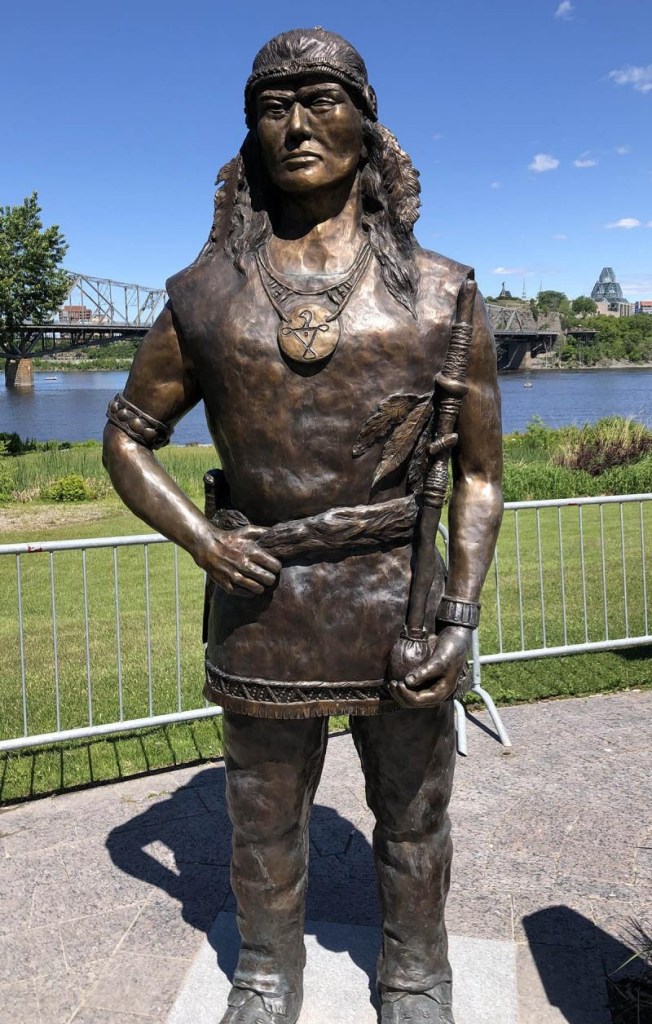
This was the first time I had heard about an indigenous burial ground downstream from the waterfalls in the Ottawa River, very near the Canadian Museum of History. So, across the river I went. I couldn’t identify the spot, but I did find a plaque about the history of the Anishnaabe who have lived and traded in the Ottawa area for thousands of years, plus a statue of Chief Tessouat, who was party to the first major alliance between Europeans and the First Nations, 400 years ago.

A metal statue of an indigenous man in traditional clothing, with the Ottawa River in the background.

I continued along the Voyageurs Trail, a 30 km route, towards Pointe Gatineau. There were more plaques with bits of history, and I stopped to read them all. I am a bit of a plaque nerd.

The next spot of interest was near a bridge I had never noticed before. Called Mawandoseg (land where our people once gathered), there is also a statue in the form of a stone point, to recall the artifacts found here that show the site had been used for millennia.

The back of a statue in the form of a stone spear or arrow point.

My next stop was in Pointe Gatineau, at Place Abinan (the people were here), a little park near the water. When excavated, this area had proven use dating back 7,000 years, with people traveling or trading widely. From just a few metres away, it was possible to see the confluence of the Ottawa, Gatineau and Rideau Rivers, waterways that made this such an important site for trade.

In the foreground is the Gatineau River as it joins the Ottawa River. On the far side, in the centre, you can just make out the Rideau Falls, where the Rideau empties into the Ottawa.

Looking across the river, I remembered the Chief Pimisi portage route around the falls, so that’s where I cycled to next. I rode through Rockcliffe Park but decided not to tackle walking down to the water, since there was no place to lock my bike. I did get a selfie looking back towards Pointe Gatineau.

Me in a turquoise and white sweater and bicycle helmet, with an orange shirt pin. In the background are trees just beginning to turn yellow and orange. place Abinan is barely visible in the far distance near my left ear.

Finally, it was time to head home. It ended up being my longest ride in years, somewhere between 27 and 28 km. Since I wasn’t wearing proper riding gear, I was grateful for all the breaks along the way. But even in proper gear, I think this was a good way for me to do a longer ride. It allowed me to combine my love of history and social justice issues with a fitness activity.

Diane Harper lives in Ottawa.

fitness

Is it too Early to Think about Winter Biking?

I hope not, because I am thinking about it a lot right now.

In some ways, I am very late to winter cycling. have been thinking about it since the miserable 51 day bus strike in the dead of winter (December 2008-January 2009). That was the first time I ever saw cyclists in the snow, and I envied them as I trudged to work, a 45 minute walk in good weather, on cleared sidewalks.

I dismissed the idea even as I reluctantly returned to public transit, instead riding my bike to work for up to 9 months of the year. Then I met a couple of colleagues at a new workplace who rode year-round for environmental reasons, and I was intrigued again. Two years ago, I actually stopped a random guy at a street light in late winter, and quizzed him about his experience and gear.

Last winter, my friend Florence introduced me to the concept of studded tires. She cycles year-round, even to swim practice (brrr). And last week she came to the Fancy Women Bike Ride in a Cleverhood rain cape like this:

Model wearing a bright yellow rain Cape poses on a red commuter bicycle.

I was starting to see ways I could feel safe and warm as a winter cyclist.

My next step was to acquire a bike I wouldn’t mind getting rusty. That came thanks to my local community mail list, where someone had an old Trek with seized gears that they wanted to give away.

Advice for how to fit it up came from the Ottawa cycling community on Twitter (which includes a lot of moms, every day commuters, and cycling infrastructure advocates, so I felt confident their advice would work for my cycling interests). One thing they said was to get the studded tires now, to avoid shortages later in the fall.

I picked up my bike from the shop on Friday. It has studded tires, fenders, new gears and brakes, a rack to hold my pannier, rechargeable lights and a bell. My new red hood is hanging by the back door, along with a pair of splash pants and my reflective vest. I have a bottle of chain oil that I will use daily, and a rag to wipe down my bike after each ride.

Red and white Trek bicycle with studded tires.

It is definitely too early for winter riding, but I am ready (and ridiculously excited).

Diane Harper is a public servant in Ottawa. She doesn’t love commuting, except by bicycle.

fitness

Fancy Women (and others) Ride Bikes

According to Wikipedia, The Fancy Women Bike Ride is an event started in 2013 by history teacher Sema Gür in Izmir, Turkey. The event draws attention to the themes of freedom and women.

This year, it was held in some 200 cities in at least 25 countries. In 2022, Sema Gür and co-organizer Pınar Pinzuti were awarded with UN World Bicycle Day Award. World Bicycle Day recognizes “the uniqueness, longevity and versatility of the bicycle as…a simple, affordable, reliable, clean and environmentally fit sustainable means of transport”.

I joined the ride in Ottawa on Sunday September 18, along with about 20 women, men, and girls.

The FIFI bloggers had debated a bit about who was being left out by calling it the Fancy Women’s Bike Ride, but I found that it was inclusive and focused specifically on safe infrastructure for all riders.

Some of us had dressed up, while others preferred sensible GoreTex. we all decorated our bikes with flowers before starting, which was rather fun.

A group of cyclists lined up in the rain, with the Ottawa River in the background.
Cyclists of all ages in brightly coloured gear.

Cycling infrastructure matters a lot to me. I have ridden my bike to work for many years, most of them on streets that were rather terrifying. Modest changes over the last few years have made my commutes feel much safer, but I am still learning where I can avoid most of the worst traffic. I have been known to rant that “paint is not infrastructure!”

Will I go again? Almost certainly. I had fun connecting with other cyclists, and exchanging notes on best gear for different weathers. I am very happy to support better cycling infrastructure too – it makes the streets and sidewalks safer and more accessible for everyone, not just cyclists.

Diane Harper lives in Ottawa. She commutes to work by bicycle, mostly for environmental reasons.

fitness

I went for a group ride

#ottawabikesocial is a group that gets together for weekly rides in different parts of Ottawa. I was intimidated by the idea of joining in, but then they posted about going for ice cream afterwards. That sounded like my kind of group!

My friend Florence rides with them regularly, so I followed her to the meet up spot, where we were joined by 25-30 people, men and women of all ages and sizes. There were people in Lycra, in casual shorts, and even one in an elegant dress and tights.

The bikes were even more varied. There were road bikes and mountain bikes, cargo bikes, electric bikes, bikes with baby seats, and even a recumbent bike and a Brompton folding bike. Plus there was Winston, a little dog who loves to ride in own basket.

A large group of cyclists at a stop sign, waiting to cross the road.

We headed at a comfortably sedate pace to the nearby bus station, where we had a chance to try using the the rack and roll system that allows cyclists to use public transit.

A group of cyclists looks on as one person demonstrates how to put his bike on the rack. Winston is in his basket on the right.

The rest of the ride took us along paths and urban streets, over the highway on a pedestrian/cyclist bridge, through parking lots and then through a park along the Rideau River to our start point..

All told, with the ride there and home, plus my commute to work today, I did about 22 km, my longest ride this summer.

As I rode with a group that pushed me out of my distance comfort zone, I was reminded of a 2007 report for Natural England about the shrinking space of childhood.

A map showing the space where four generations of children in one family were allowed to go without an adult, all at age eight. It shrank from 10 km for the great-grandfather, to less than half a kilometre for the great-grandson.

On my bicycle, I can be like the great-grandfather. I have the freedom to go a fair distance. Things are closer than they appear, and often it is almost as fast to get there by bike as it is by car.

Happy me in a pink cycling jersey and my blue helmet after the ride, with more cyclists in the background.

How about you dear readers? What have you tried that turned out to be less scary than you thought? What did you learn from the experience?

Diane Harper lives in Ottawa, where she mostly uses her bike to commute to work.