diversity · mindfulness

National Day for Truth and Reconciliation

I have done a lot of overthinking about this post and that overthinking is a very familiar pattern for me.

As I have mentioned many, many times on the blog, I often get caught in thought loops that look like this 

I understand that change needs to happen.

I start with good intentions.

I want to do something the ‘right’ way (or, at the very least, I don’t want to do it ‘wrong’)

I overthink and worry about it.  (sometimes I seek certainty by doing a ridiculous amount of unstructured research that doesn’t help at all)

I don’t actually take the action because I am so concerned with doing it right that I can’t do anything at all. 

I get upset with myself and start the loop again. 

And when it comes to the National Day for Truth and Reconciliation, for decolonization, for reconciliation practices as a whole, I admit that I have gotten firmly stuck in this loop, over and over again. 

I get so caught up in trying to do a good job, in trying to do reconciliation ‘right’, that I end up not taking any useful or sustained actions.  

I often have an idea what NOT to do* but I sometimes get so tangled up in avoiding those wrong things that I don’t leave myself room to do anything at all.

I’m tired of this loop and I am getting out of it.

https://firstlightnl.ca/community-events/orange-shirt-day/
My shirt for National Truth and Reconciliation Day/Orange Shirt Day. The idea of someone asking me why I am wearing orange immediately makes me fear that I will give the ‘wrong’ answer but being willing to make mistakes is all part of the process. Image description: a close-up image of an orange tshirt with white text that reads ‘ask me why I am wearing orange.’

Recently, a friend of mine told me that she sees a lot of people in loops like this – good intentions, overwhelm, guilt, inaction – and she told me the cure: 

EDUCATION. 

It was both incredibly obvious and a great revelation. **

Obviously, education will help me to understand how to be useful, how to figure out what actions to take, how to do things ‘right enough.’

The revelation was that educating myself is very different than getting caught in a whole loop of researching for certainty.

Thank you, M-L, for helping me to take a step in the right direction.


First Light, an Indigenous organization in St. John’s, NL, has a social media campaign asking people to state their commitment for the National Day of Truth and Reconciliation

In the spirit of that request, here are my first set of commitments to educate myself and work towards reconciliation:

  1. I will attend the Reconciliation Rally this afternoon and wear my orange shirt.
  2. I will take the 8 hour version of First Light’s Indigenous Cultural Diversity Training.
  3. I will read Decolonization and Me by Kristy McLeod and Phyllis Webstad.
  4. I will take the University of Alberta’s Faculty of Native Studies’ ‘Indigenous Canada online course.

Now, I want to be clear that I understand that this is not a checklist – I can’t “finish” reconciliation…I can’t even “finish” educating myself.

I understand that reconciliation is about learning new ways of thinking, about new ways of being in relationship with each other, with other species, and with the land.

I understand that there are so very many things that I don’t know, and that I have a lot to unlearn.

I recognize that reconciliation is a very long-term, ongoing project and that it will involve making mistakes and learning from them.

But I refuse to stay in the loop of good intentions with very little action any longer – almost anything I do will be better than that.

And, as recommended, I am starting with seeking education about the truth of Indigenous experiences.

This Living Acknowledgement from First Light is so moving that I wanted to ensure that you had the opportunity to watch it, too. Still image description: two young Indigenous women smile at the camera. They both have dark hair and they have their hair pinned up in braids. The one on the left is wearing a flowered top and the one on the right is wearing a green to and she has glasses.

(This post has been edited to add the two items below. The first one didn’t travel along with the copy and paste from my draft document. The second one was added for clarity after the post went live.)

*For example: I am currently wrestling with thoughts that writing this post this way is centering myself – I know not to do that but I’m not sure if this is an example of that or not. I hope not. I hope this is a loop-breaking way of starting to take the actions I want to take to educate myself properly.

**To clarify a little – It’s not that I thought I knew everything already, it’s that some part of my brain thinks that I don’t know what to do because I haven’t thought about it enough or because I haven’t asked the right questions yet. I forget that the path (and the questions) come from learning – I don’t need to know them before I start. Is this an ADHD thing? A Christine thing? A human thing? It’s probably a combination, right?

Update:

The rally was incredibly moving and incredibly hopeful.

Here are a couple of photos:

A photo of a statue of John Cabot wrapped in orange t-shirts
The representative from First Light gave a strong speech about how John Cabot didn’t ’discover’ this land and how Turtle Island was well-populated long before Cabot showed up. Image description: A bronze statue of John Cabot wrapped in orange shirts that say ‘ask me why I am wearing orange.’ The statue stands on the steps of the Confederation Bldg (the NL House of Assembly) and there are several people between me and the statue. There are happy children playing on the steps behind the statue – a hopeful contrast to the sombre reason for gathering today.
A photo of a statue of a Beothuk family
The drummers played a steady beat as a long lineup of people laid tobacco ties at the feet of this statue of Demasduit’s family . Demasduit was a Beothuk woman who was captured by settlers who killed her husband (Nonosabasut) in the process. Her baby died two days after her capture. The speaker reminded us that the statue symbolizes all of the Indigenous families torn apart by colonization. Image description: a bronze statue of a Beothuk woman and her husband holding their baby. There are a lot of small red tobacco ties placed at their feet. Two Indigenous drummers (one in a ribbon skirt) are standing nearby. There are a crowd of people in orange shirts between me and the statues.
fitness · mindfulness · walking

Walking Quiet, Walking Loud

I usually like to listen to podcasts or audiobooks* to add some extra fun when I take Khalee for a walk. On challenging days, when my walk would be filled with unhelpful rumination, focusing on a different narrative is really helpful.

However, me being me, I end up overthinking everything, including the fact that I listen to stuff while I walk.

Would it be better to walk quietly and just observe?

Should I make an effort to do walking meditations more often?

Would walking mindfully serve the same brain-clearing purpose as immersing myself in a narrative does?

A top down photo of a dog next to a bush with large pink flowers on it.
Khalee doesn’t listen to podcasts while she walks and she also doesn’t worry about whether it’s the right thing to do.

image description: A fairly close-up, top-down photo of Khalee, my light-haired dog, walking on some grass right past a large pink flower on a short bush. She is facing to the right and her head and shoulders are in the frame. The bush with the link flowers is to her left at the top of the image.

I didn’t know the answer to these questions so I’ve been choosing to walk without my headphones**every so often lately, just to see how I feel about it.

It turns out that I like it…as an occasional thing.

It’s good to take a break from my usual routine and I enjoy choosing to let my mind wander as I walk.

And it was interesting to realize that while I’m obviously more mindful while walking without headphones, it turns out that I am generally pretty observant on all my walks.

Even with my headphones on, I notice changes in my neighbourhood. I see different flowers and trees growing. I stop to take pictures.

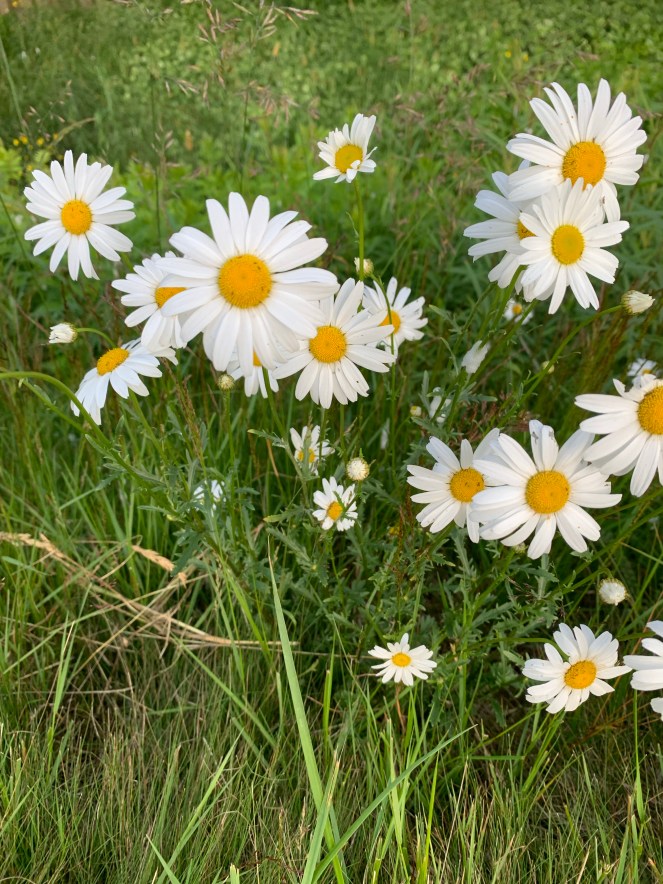
A bunch of white daisies growing in some grass.
For example, I had to stop and get a photo of these happy daisies when I saw them recently. Image description: at least a dozen daisies growing tall amidst some grass. The daisies have white petals and yellow middles.

That’s not the behaviour of someone who is zoned out or too caught up in her entertainment to notice the world around her.

Waking loud (i.e. with headphones) or walking quiet (i.e. without headphones) turns out to be one of those situations where I can have it both ways.

Either type of walk is enjoyable and they both do me some good.

So I guess I’ll just play it by ear (ha!) from now on.

PS – What do you do when you’re walking? Are your headphones on or off?

*I have been having a great time listening to Ghostly Thistle’s fiction podcast The Antique Shop lately and I recently enjoyed Kate Racculia’s book Tuesday Mooney Talks to Ghosts narrated by Lauren Fortgang.

**Well, headphone, singular, I don’t use two headphones while walking so I can stay aware of my surroundings. I only use two when I am wearing my hatphones – they don’t block out noise the way my regular headphones do.