



Cressida J. Heyes
In 2004 British artist Sam Taylor-Wood (now Taylor-Johnson) made a short film of the footballer David Beckham asleep. You can watch all 107 minutes of it on her website. Beckham lies on his side, dimly (and flatteringly) lit, hands adorably tucked up by his face, his then-blond hair in a cowlick, as he occasionally stirs and the covers slide to reveal a glimpse of pec. As the title of a popular sleep podcast would have it, Nothing Much Happens.

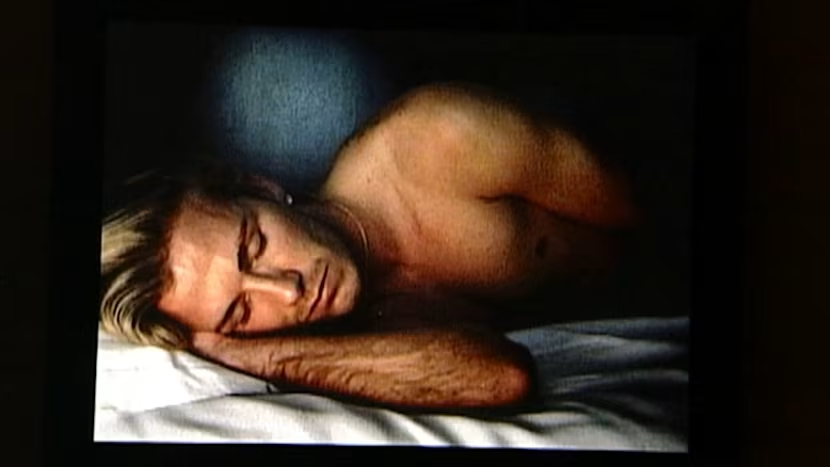
Nonetheless, a friend of mine told me that when the film was shown at London’s National Portrait Gallery, there was a very long queue of would-be viewers, mostly women. Watching someone sleep is a form of intimacy and a rather opaque window into their private life. This artwork also provided an opportunity to witness Beckham in bed, which is perhaps where many people imagined they would most like to encounter him.
Less often remarked on is the fact that “David” (as the film was simply titled, in an obvious nod to Michelangelo) was filmed in the middle of the day in a Spanish hotel room. Beckham was at the time playing for the elite club Real Madrid, and following a morning training session the players were expected to take a long siesta. Getting adequate rest has long been a feature of best practice in training, with athletes advised to take regular days off for recovery, and—a bit more recently—to get plenty of good quality sleep. Elite athletes probably face some challenges that the rest of us don’t: the average weekend warrior isn’t jetting across three North American time zones for Stanley Cup finals, or being forced to get up before dawn to fit training for the Olympics around a day job. Nonetheless, increasingly sleep is recommended for the average fitness enthusiast, rather paradoxically, as an integral part of a physically active lifestyle.
In the sleep medicine literature, sleep is often represented as a period of “recovery” following physical and mental exertion—even if just the cognitive exertion of being awake. Exactly what we are recovering from or how this process happens is still not well understood. Some evidence suggests (rather unsurprisingly) that sleep deprivation has a negative effect on performance, so if you are in the biz of working out, focusing on sufficient and consistent sleep is wise, and, conversely, regular exercise is shown to improve sleep duration and quality.
So far, so good. By now we all know that good sleep means going to bed (and getting up) at a consistent time, not using blue-light devices before bed, avoiding caffeine and alcohol, sleeping in a dark and cool room, and a host of other common-sense “sleep hygiene” steps. Sleep trackers can only capture crude measures—evaluating self-reporting of bedtime and wake time; keeping track of your temperature, blood oxygen levels, heart rate, and respiration; or measuring body movements at night to gauge your sleep cycles. This kind of data is nothing compared with the neurological information a sleep tech would gather in a sleep lab.
Nonetheless, now, apparently (h/t Fit is a Feminist Issue), there are also apps to optimize your sleep for your workout:


The language here is telling, and exceeds the technological promise of the app, moving into existential territory: sleep is “not just downtime, it’s part of the workout.” It’s “about more than just ‘rest.’ It’s when your body goes to work repairing muscles, regulating hormones, consolidating skills learned in training, and restoring the energy you’ll need for tomorrow’s effort.” The makers of GOWOD “think of sleep as a hidden workout – an invisible lever that can unlock your best results if you choose to use it.”
Here’s another way of thinking about sleep. As “David” shows, even for one of the world’s most visible and successful athletes, the sleep that is a central part of his training is something private and mysterious, not typically available to public scrutiny. Whatever “recovery” is happening while we sleep is, for now, hidden from view. Sleep tracking may quantify some proxies for sleep, but it doesn’t, in fact, tell us all that much about sleep itself (whatever that is), which is perhaps why it is so easy to claim it is “part of the workout.” I’m not against athletes (or anyone else) getting better sleep—far from it. But the incorporation of tonight’s sleep into tomorrow’s effort negates its inherent value and instrumentalizes it. Instead, let’s think of sleep as a part of our experience that may not be 100% available to quantify and deploy in the service of waking life, but as necessarily a tiny bit ineffable and existentially sacred—something you would line up to watch for 107 minutes and wonder at.
Listen to Cressida’s podcast Sleep is the New Sex on Apple or at sleepisthenewsex.ca